George Herman Washington
Leave the World BehindGeorge Herman Washington is a financially astute homeowner whose reading of the yield curve has alerted him to danger before he can explain it to the people around him. The blackout brings that private foreknowledge into his household: he and Ruth arrive at a house occupied by paying renters, and he must decide what ownership, hospitality, and useful knowledge mean when ordinary assurances are failing.
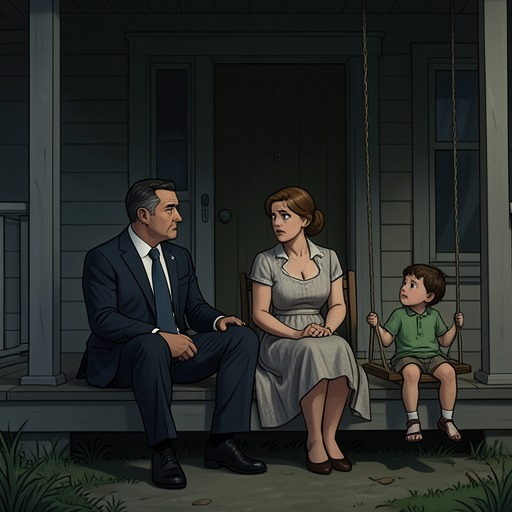
Identity and First Encounter
George Herman Washington first meets Amanda and Clay as a stranger in the house they have rented. Amanda, usually proud of her ability to recognize the people who do business with her, sees only a Black man she has never met. Clay tries to ease the encounter by assuming that the two households already know each other. George Herman Washington introduces himself by his initials, G. H.; the letters mean nothing to Amanda, who cannot tell whether he is trying to spell something. He is also called George, a name that feels gentler in a moment when everyone needs to appear human and no one knows who might be armed or ready to stand their ground.
The distinction between his names is deliberate: he thinks of himself as George but speaks of himself as G. H. The contrast gives his introduction a social as well as personal dimension. His manner has the practiced quality of a salesman, which the narration connects to his actual work, and he explains that he and Ruth have emailed with the renters about the house. His effort to sound both firm and gentle reflects the situation: the newcomers are in his home, but they have paid for it, and the emergency has not erased that fact.
Homeownership and Hospitality Under Pressure
When Clay offers water, the question of who is host and who is guest remains unsettled. George Herman Washington confirms that the house is his and later makes clear to Ruth that the renters paid for it. Although he drove fast to get back, he knows that some things cannot be outrun. He cannot simply throw Amanda and Clay out, nor does he want to. His position is not a surrender of ownership; it is a recognition that the household has obligations to people who have paid to stay there even as the crisis makes their arrangement newly precarious.
The tension between property and welcome is sharpened by the ordinary marks of rental life. Ruth recalls that they have generally had good luck with renters, despite the occasional broken wineglass, loose doorknob, or missing soap dish, which she replaced with a large seashell. She also points out that Amanda has left the kitchen dirty. These small domestic particulars give the disruption a material scale: the house is not an abstraction or a refuge with no prior claims, but a home whose owners have accommodated strangers and whose familiar rules are now under strain.
Information, Finance, and Foreknowledge
George Herman Washington manages money, and he describes information as indispensable to the work: without it, a person cannot make choices or assess risks. Money matters too, he acknowledges, but information is the decisive instrument. That conviction makes his reaction to the blackout more complex than simple alarm. When Amanda reports news alerts, he is less troubled by their announcement of a major blackout on the East Coast of the United States than by a message that appears as gibberish. His concern turns partly toward the technology carrying the news, not just the national emergency it reports.
His professional habits have already led him to suspect that something is coming. The narration calls his business clairvoyance, then grounds that description in his attention to the yield curve: its rise and fall, like an inchworm’s inefficient progress, has told him what he needs to know. He had distrusted its particular shape; to him it was more than a portent, it was a promise. Yet foreseeing danger does not give him a full explanation or a way to prevent it. He knows that something is truly wrong, but does not tell the renters that he had expected it. His reticence marks the gap between recognizing a signal and being able to make others understand what it means.
Family, Civic Life, and a Changing Confidence
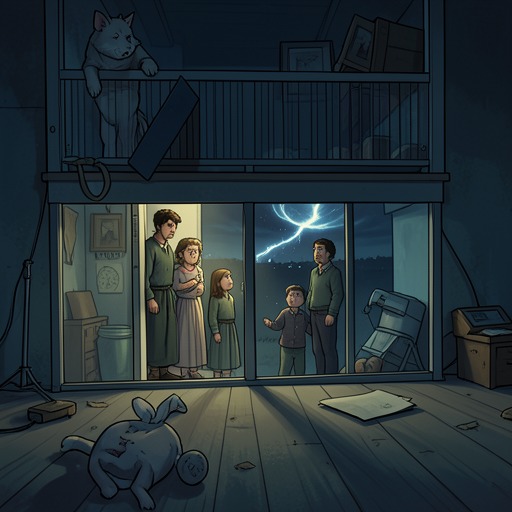
In the house’s dark lower level, George Herman Washington switches on lights as he leads the way. The narrator notes his surprise at how strongly light signifies safety and darkness its opposite, despite his having been unafraid of the dark as a boy. He cautions Ruth to watch her step with tenderness, while she grips the railing and insists that the house is hers. Their exchange shows a marriage negotiating both immediate physical unease and the familiar claim of belonging. The basement had been intended for Ruth’s mother, who died before visiting; this family history makes the house more than a financial asset or rental property.
George Herman Washington’s public commitments also enter the first meeting. He and Ruth had been at a symphony in the Bronx that night, and Ruth explains that he serves on the New York Philharmonic’s board to encourage interest in classical music. Her pride in him spills into an overlong explanation, revealing civic giving as part of how the couple understands their place in the community. Against that established confidence, his later doubts are striking. He suspects terrorism but says that it is not what frightens him most; he questions whether American institutions, and the president in particular, would respond properly if New York City were attacked. What once sounded like paranoia now seems to him like pragmatism. His arc in these scenes is not from ignorance to certainty, but from professional confidence in reading information to a more unsettled recognition that neither foresight, property, nor public institutions can guarantee safety.